
The warehouse used to be one of the clearest physical signs that an e-commerce business was growing.
More orders meant more stock, more space, more people and eventually a bigger distribution operation. Increasingly, successful e-commerce brands are scaling without building that infrastructure themselves.
For a generation of online retailers, growth followed a fairly predictable path. The spare room became a small unit. The small unit became a warehouse. More orders meant more warehouse staff, more systems, more carrier relationships and, eventually, another conversation about whether the business was running out of space again.
Third-party logistics (3PL) is changing that trajectory. Outsourced fulfilment has become part of the growth infrastructure behind businesses processing significant order volumes, entering new territories and managing increasingly complicated international operations. And the evidence suggests that outsourcing logistics isn't something businesses necessarily grow out of.
For some brands, outsourcing fulfilment is no longer simply a response to outgrowing their existing warehouse. It is part of the business model from the outset, allowing management to concentrate investment on the products, technology, marketing and customer relationships that drive growth.
Scaling the brand, not the warehouse
There are already interesting examples of this model amongst British e-commerce businesses.
Premium cat-food subscription brand Untamed worked with a third-party fulfilment provider before it even launched in 2020. Five years later, its fulfilment operation was dispatching more than 1,000 personalised orders every day.
British childrenswear brand Apolina has worked with a 3PL since 2019. Its fulfilment partner reports that order volumes have subsequently increased by 470%, with the brand now shipping to more than 35 countries.
At the other end of the scale, Gymshark has incorporated third-party logistics into its international operations as it has grown into a global brand.
From a subscription-led challenger brand to an internationally recognised retailer, these examples challenge the assumption that a growing e-commerce business must own the infrastructure behind every order.
Outsourcing fulfilment can release capital and management capacity for other priorities. But it also changes the financial decisions facing the business.
The question becomes less about whether to build another warehouse and more about where investment will generate the greatest return.
Contact MWA Accounting
We're flexible let us know what works best for you...
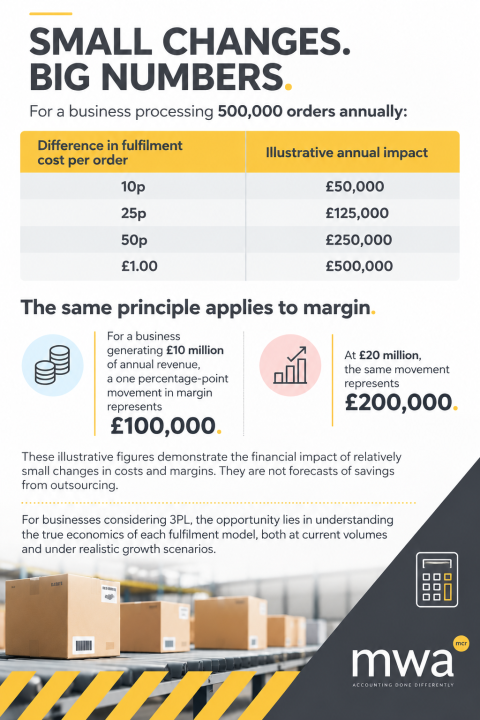
SMALL CHANGES. BIG NUMBERS.
For an established e-commerce business, the decision to outsource fulfilment involves considerably more than comparing warehouse rent with a 3PL invoice.
An in-house operation carries staffing, property, technology, equipment and management costs. Outsourcing changes that cost structure, but doesn't automatically reduce the total.
The commercial case depends on the business's order volumes, product profile, storage requirements, returns and future growth plans.
And relatively small differences in fulfilment costs can have a substantial financial impact.
The 3PL paradox: your stock gets further away
There is an interesting consequence of outsourced fulfilment: management can become physically further removed from one of the most valuable assets in the business.
Its stock.
Potentially millions of pounds of inventory can sit across third-party warehouses without the people responsible for financial performance routinely seeing any of it.
A 3PL system might provide an accurate count of the units sitting in each location. But quantity isn’t the same as value.
Stock may be slow-moving, damaged, returned, obsolete or simply falling out of demand. Knowing there are 5,000 units of a SKU doesn't tell you how long they have been there, how many can genuinely be resold or whether their inventory valuation still reflects commercial reality.
It also doesn’t show which products are tying up cash that could be put to better use elsewhere in the business. The physical stock may have moved outside the business. The financial responsibility for understanding it hasn’t.
Outsourcing physical visibility makes financial visibility more important, not less.
Your 3PL tells you what’s happening. Your numbers tell you what it means.
A good 3PL should provide detailed information about what’s happening inside the warehouse.
But operational data only tells part of the story.
If storage charges are increasing while inventory is falling, what’s driving it? If returns are rising, what is that doing to product profitability? If fulfilment cost per order is increasing, what's happening to contribution margin after fulfilment and returns?
And do the business’s stock and order records actually agree with the information coming from the 3PL?
Those questions become even more important when the business changes.
International expansion, new sales channels, different product ranges and increasing order volumes can all alter the economics of fulfilment. A model that works today may not remain the best commercial option indefinitely.
Another fulfilment location might make sense. Rates may need renegotiating. At some point, even bringing some fulfilment back in-house could become commercially attractive.
Good financial information doesn’t simply explain what has already happened. It helps the business decide what to do next.
Why growing e-commerce businesses need more than year-end accounts
For an established e-commerce business, accurate accounts are essential. Stock must be correctly valued, 3PL charges reconciled, and VAT, tax and financial reporting managed properly.
But understanding what has happened is only part of the picture.
At MWA Accounting, we've spent more than a decade working with e-commerce businesses, helping them navigate the financial challenges that accompany growth.
Our Virtual Finance service provides ongoing financial visibility through management accounts, cash-flow forecasting, inventory reporting, margin analysis and commercial KPIs.
Our Strategic Advisory services take that information further, helping business owners make informed decisions about investment, profitability and future growth.
For a business considering 3PL, that might mean modelling outsourced fulfilment against expanding an existing operation.
For an established 3PL user, it could involve assessing profitability by sales channel, forecasting the cash required for international expansion or determining whether the current fulfilment model remains commercially competitive.
Because the real value of financial information isn't simply knowing that the numbers are correct. It's understanding what they tell you to do next.
Outsourcing the warehouse makes financial visibility more important, not less
Third-party logistics has changed what's possible for ambitious e-commerce brands.
Businesses can expand into new markets, increase order volumes and build sophisticated fulfilment operations without necessarily owning the infrastructure behind them.
But as more of the operation moves outside the business, having clear financial visibility becomes increasingly important.
Understanding inventory value, fulfilment costs, working capital and profitability – and how those numbers are changing – is essential to making good commercial decisions. The infrastructure may be outsourced.
The need for financial insight isn't.
That doesn't mean the finance function has to sit entirely in-house either.
MWA Accounting provides specialist e-commerce accounting, Virtual Finance and Strategic Advisory services, giving growing online businesses access to the financial insight and expertise they need without necessarily building a full internal finance function.
Whether you're considering moving to a 3PL, reviewing an existing fulfilment arrangement or planning your next stage of growth, we can help you understand the financial implications, model the options and use the numbers to make informed decisions.
Disclaimer: This article is for general information only and reflects our understanding of the law and HMRC practice at the date of publication. It should not be relied upon as advice. Professional advice should be sought before taking or refraining from any action.
Learn more about how we can support your business...

Related articles